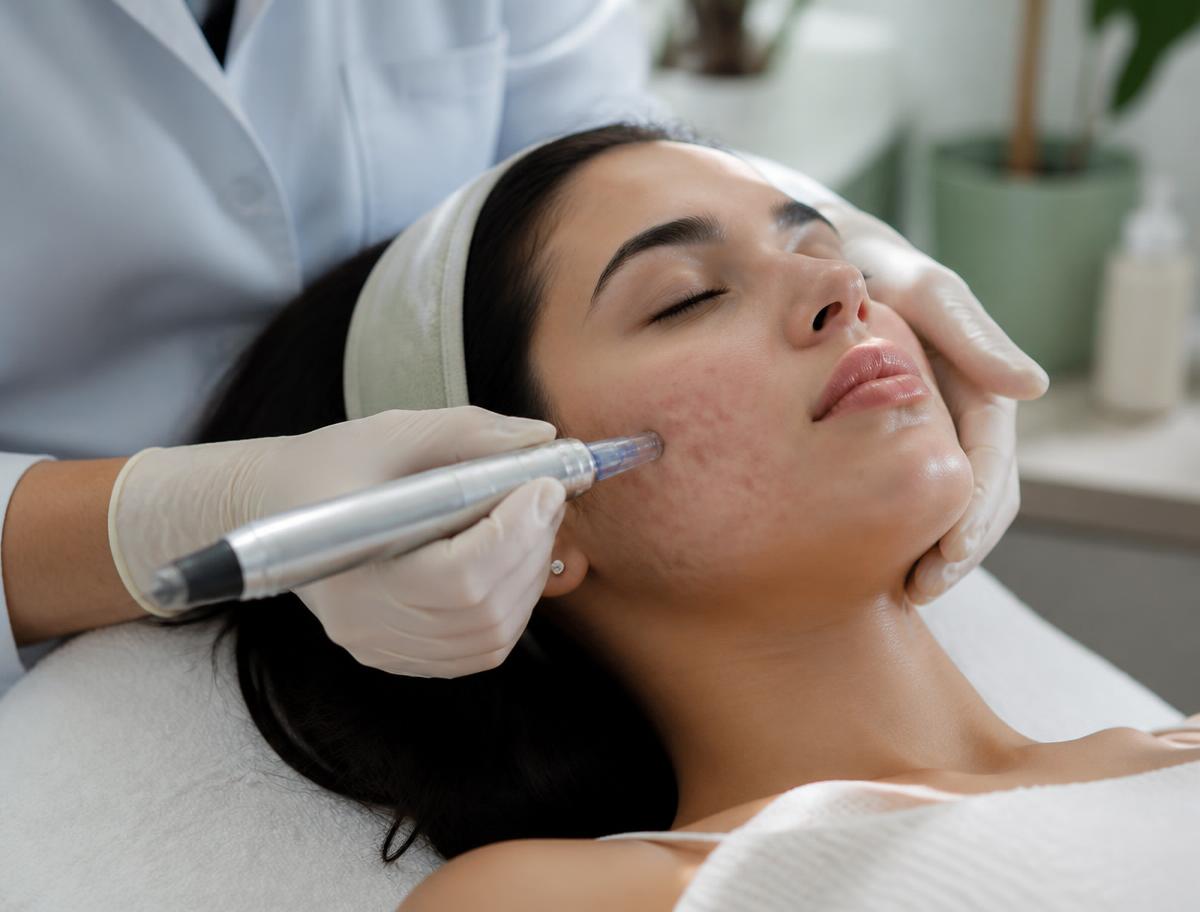
Bringing active acne under control and individually planned scar treatment based on scar type.
Acne Treatment
Acne is a very common skin disease presenting with blackheads and whiteheads (comedones), red inflamed pimples and, in some people, deep-seated nodules and cysts. Although it is most common in adolescence, it can continue into adulthood or appear for the first time in adult years.
The aim of acne treatment is not only to clear existing pimples, but also to reduce new breakouts and prevent pigmentation and permanent acne scarring.
How Is Acne Treated?
Treatment is planned according to the type and severity of acne, the person's age, skin structure and tendency to scar.
In mild to moderate acne, retinoids, benzoyl peroxide, azelaic acid and, when necessary, topical antibiotics can be used. In more widespread inflammatory acne, oral antibiotics and, in suitable female patients, hormonal therapies may be used; in severe acne with a high scarring risk or resistance to other treatments, oral isotretinoin may be preferred.
During treatment it is also important to use a suitable cleanser, moisturiser and sunscreen to protect the skin barrier.
Appointment
Acne severity and scar type are assessed together during the examination and a plan is created.
The red or pink marks left after pimples heal are called PIE (post-inflammatory erythema). These are not depressed acne scars. For persistent red marks in particular, IPL treatments targeting vascular structures can be helpful.
02
Post-Acne Brown Marks (PIH)
Brown marks remaining after acne are called PIH (post-inflammatory hyperpigmentation). Sun protection, retinoids, azelaic acid, brightening products and chemical peels can be used in treatment.
Frequently Asked Questions
About Acne Treatment
How long does acne treatment take?+
The effect of treatment usually appears within weeks. Evaluating clear results often takes a few months.
Does acne only occur in teenagers?+
No. Acne can also occur in adult women and men.
Does squeezing pimples leave scars?+
Yes. Squeezing pimples increases inflammation and can raise the risk of pigmentation and permanent scarring.
Should a moisturiser be used during acne treatment?+
Yes. Especially during drying acne treatments, using a suitable moisturiser helps protect the skin barrier.
Acne Scars
Acne Scars
Acne scars are permanent tissue changes that can appear after active acne lesions heal. Depressed scars, scars resembling enlarged pores, raised scars and the red or brown marks left after acne all have different characteristics, and treatment approaches vary accordingly.
The first and most important step in scar treatment is correctly identifying the scar type. Rather than applying the same device or procedure to every scar, it is more appropriate to assess the depth and shape of the scar along with the skin structure and create an individual treatment plan.
For depressed acne scars, fractional microneedling radiofrequency (gold needle), subcision, TCA CROSS, mesotherapy, biostimulator treatments and minimal filler applications can be used alone or in combination according to the person's needs.
Why Do Acne Scars Form?
The inflammation that occurs in the skin during acne can damage the collagen structure of the dermis. When insufficient collagen forms during healing, depressed (atrophic) scars develop; when excess tissue forms, raised scars can develop.
The risk of scarring is higher in deep, inflammatory and long-lasting acne. Before starting scar treatment it is important to bring active acne under control as far as possible, since new scars can develop while new lesions continue to form.
Scar Types
What Are the Types of Acne Scars?
Depressed acne scars are generally considered in three main groups.
01
Ice-Pick Acne Scars
Ice-pick scars are narrow, sharply defined scars that extend from the skin surface deep into the dermis.
Surface treatments are not always sufficient for this type of scar. In suitable ice-pick scars in particular, TCA CROSS can be included in the treatment plan.
02
Rolling Acne Scars
Rolling scars are broader scars that create a wavy, depressed appearance on the skin surface.
Fibrous bands that pull the skin downwards can lie beneath these scars. For this reason subcision is one of the key treatment options for rolling scars.
03
Boxcar Acne Scars
Boxcar scars are wider depressed scars with round or angular edges.
Depending on the depth of the scar, fractional microneedling radiofrequency, subcision, TCA CROSS or different combinations can be used.
More than one scar type can be present on the same face. For this reason treatment rarely consists of a single method.
Treatment Methods
Methods Used in Acne Scar Treatment
01
Gold Needle for Acne Scars (Fractional Microneedling Radiofrequency)
Fractional microneedling radiofrequency, popularly known as the gold needle, is one of the methods most frequently used in the treatment of acne scars.
Radiofrequency energy is delivered through microneedles to predetermined depths of the skin. The controlled thermal effect aims to support collagen production and dermal remodelling.
Needle depth and energy level can be adjusted according to the region and the depth of the scar.
Particularly;
Boxcar scars,
Rolling scars,
Irregularities of the skin surface,
Enlarged pore appearance,
Skin quality problems accompanying acne scars
tercih edilir.
02
What Is Subcision?
Subcision is a procedure performed to release the fibrous bands that tether depressed acne scars to the underlying tissue. It can be preferred especially for broad, wavy rolling scars whose appearance improves when the skin is stretched.
During the procedure the fibrous attachments beneath the scar are released with a needle or cannula. The aim is to reduce the downward pull on the skin and help the depression lift. Temporary bruising, swelling and tenderness may occur afterwards.
In some people subcision alone may be sufficient, while in others it can be planned together with the gold needle, biostimulators or fillers for a better result.
03
What Is TCA CROSS?
TCA CROSS is a focal chemical application used particularly for narrow and deep acne scars. “CROSS” refers to the controlled application of high-concentration trichloroacetic acid only inside the scar.
TCA CROSS can be preferred especially for ice-pick and selected deep boxcar scars.
The acid is applied in very small amounts inside the scar only, not to the whole face. The controlled injury aims to support new collagen formation and gradual lifting of the scar towards the surface. Small crusts may form on the treated points afterwards; not picking the crusts and protecting from the sun are important.
04
Mesotherapy for Acne Scars
Mesotherapy is the delivery of various ingredients into the skin through small injections to support its renewal and repair processes.
In scar treatment mesotherapy does not mechanically release the scar or directly change its depth. It is added to the plan mainly to support skin quality, hydration and renewal, and can be combined with the gold needle, subcision or other scar treatments as needed.
05
Biostimulator Treatments for Acne Scars
Biostimulators are injectable treatments that aim to support the tissue's own collagen production. Since atrophic acne scars involve collagen loss, biostimulators can be used in suitable people to help improve dermal support and skin quality.
Clinical studies report improvement in atrophic scars with polynucleotides and some collagen-stimulating treatments. Biostimulators can be planned as a supportive step alongside structural treatments such as the gold needle or subcision.
06
Minimal Filler Applications for Acne Scars
In some depressed acne scars, very small amounts of hyaluronic acid filler can be used to support the volume loss beneath the scar.
The aim is not to fill or volumise the face but to provide a minimal amount of support beneath scars with marked depression. Filler can be added to the plan particularly for some rolling or boxcar scars released after subcision.
Randomised clinical studies show that hyaluronic acid fillers can improve the appearance of atrophic acne scars.
Session Plan
How Many Sessions Does Acne Scar Treatment Take?
There is no standard number of sessions that applies to everyone. The number of sessions depends on;
The type of scar,
The depth of the scar,
The number of scars,
The method used,
The person's skin type,
The response to treatment
göre değişir. Çoğu kişide tedavi bir süreç şeklinde planlanır ve farklı seanslarda farklı yöntemler uygulanabilir.
Expectations
Do Acne Scars Disappear Completely?
The aim of scar treatment is not to make the skin completely scar-free, but to reduce the depth and visibility of scars as much as possible and make the skin surface more even.
The response varies with the type, depth and age of the scar and the person's collagen response. For deep, long-standing scars, marked improvement rather than complete disappearance is a more realistic goal.
Frequently Asked Questions
Frequently Asked Questions About Acne and Acne Scar Treatment
Choosing the right method starts with correctly identifying the scar type.
Can acne scar treatment be done while acne is still active?+
Treatment of active acne and of scars can be planned together. Controlling active acne is important to prevent new scars, but it is not always necessary to wait for acne to clear completely before starting scar treatment. Treating scars early helps prevent them from becoming more permanent and pronounced and can improve the response to treatment.
Which treatment is used for which acne scar?+
No single method suits all acne scars. In general, subcision is considered for rolling scars, TCA CROSS for ice-pick scars, and fractional microneedling radiofrequency for boxcar scars and surface irregularities. However, scars are usually mixed in type, so treatment is planned by assessing the individual face.
Does the gold needle clear all acne scars?+
No. Fractional microneedling radiofrequency can be effective for many atrophic scars, but it does not directly release the fibrous bands pulling the skin down and may not sufficiently treat very deep ice-pick scars on its own. It is therefore combined with methods such as subcision or TCA CROSS when needed.
Is TCA CROSS applied to the whole face?+
No. Unlike a classic chemical peel, TCA CROSS is applied focally only inside suitable acne scars.
Can filler be used for acne scars?+
Yes, in suitable depressed scars. Particularly in some rolling and boxcar scars, very small amounts of hyaluronic acid filler can support the area beneath the scar. The aim is not to volumise the face but only to reduce the depression of specific scars.
Can biostimulators be used for acne scars?+
They can be used in suitable people. The aim of biostimulators is to support the skin's own collagen production and improve dermal quality. They are usually considered complementary to other procedures targeting the scar type.
Are acne marks and acne scars the same thing?+
No. The red or brown discolouration left after acne may not be a true depressed scar, whereas a scar creates a structural change in the skin surface. Their treatments differ, so it is important to distinguish between them before treatment.
Can acne scar treatment be done in summer?+
Yes, some scar treatments can be performed in summer. Methods such as the gold needle (microneedling radiofrequency) can be applied in summer with appropriate sun protection. For IPL and some lasers, skin type, tanning and sun exposure are particularly important. Treatments creating controlled chemical injury, such as TCA CROSS, are usually preferred in autumn and winter to reduce the risk of pigmentation.
01
Should You Wait for Acne to Clear Completely Before Scar Treatment?
No. It is not always necessary to wait for active acne to clear completely before starting scar treatment.
Especially in people prone to scarring, rather than waiting months for acne alone to settle, active acne and developing scars can be assessed together and treatment planned accordingly.
In suitable patients, methods such as fractional microneedling radiofrequency (gold needle) can be added while acne treatment continues. Depending on the scar type, subcision, TCA CROSS or other scar treatments can also be scheduled at the appropriate time.
02
Can the Gold Needle Be Used During Drying Acne Treatments?
Medications used in acne treatment such as retinoids and oral isotretinoin can cause dryness and sensitivity. However, this does not mean the gold needle must be postponed in every patient.
The decision is made according to the person's current treatment, the condition of the skin barrier, the severity of active acne and the device parameters to be used.
If there is intense irritation or marked barrier impairment the procedure can be postponed; in suitable patients acne treatment and scar treatment can be carried out together.
Assessment
Acne Scar Treatment Is Planned Individually
A successful treatment plan is based on correctly identifying the scar type. Ice-pick, rolling and boxcar scars have different characteristics and are not treated with the same method.
Depending on the person's scar structure, fractional microneedling radiofrequency (gold needle), subcision, TCA CROSS, mesotherapy, biostimulators and fillers can be used alone or in combination.
The aim is not to erase every scar in a single session, but to target each scar with the right method and gradually make the skin surface smoother and more even.