



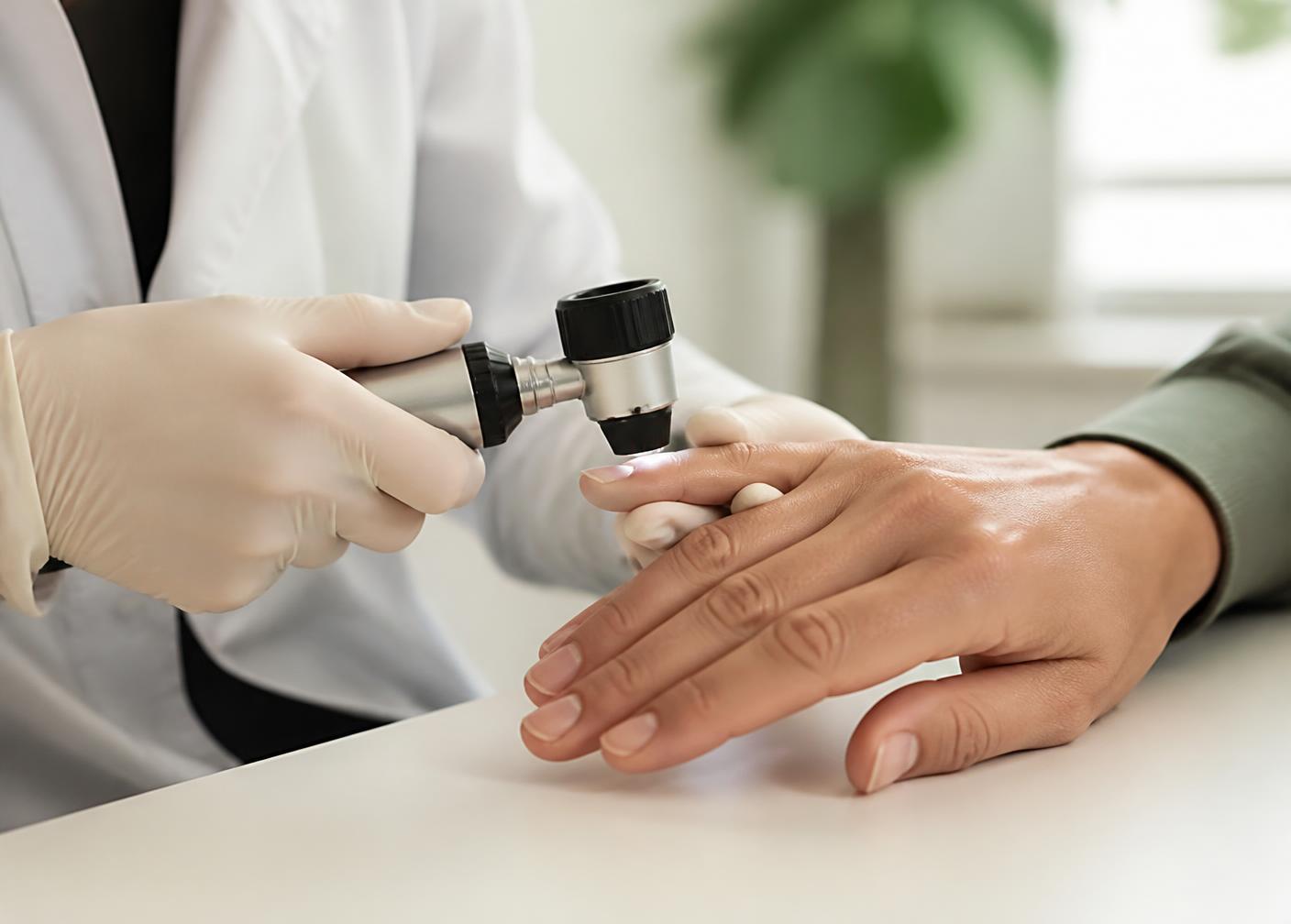
Dermatological Treatments
Nail Disorders and Nail Removal
Tırnak mantarı, batık tırnak ve renk değişikliklerinde önce doğru tanı, sonra kişiye özel tedavi.
Overview
Changes in the colour, shape, thickness and surface of nails may not be merely a cosmetic problem. Nail fungus, ingrown nails, trauma, inflammatory skin diseases and, more rarely, nail tumours can cause similar changes.
For this reason, an accurate diagnosis before treatment is essential in nail disorders.
The Most Common Nail Disorders
Nail problems frequently seen in dermatology include;
- Nail fungus (onychomycosis),
- Ingrown nails,
- Infections around the nail,
- Trauma-related nail disorders,
- Thickening and shape changes of the nail,
- Separation of the nail from its bed (onycholysis),
- Nail changes due to psoriasis,
- Nail involvement caused by dermatological diseases such as lichen planus,
- Colour changes and pigmentation of the nail,
- Masses or tumours under and around the nail
are among them.

Appointment
For nail complaints the diagnosis is clarified first; treatment is planned accordingly.
Appointment · +90 533 551 41 62Onychomycosis
How Is Nail Fungus Recognised?
Nail fungus may cause yellowing, whitening, thickening, breaking, crumbling or separation of the nail from its bed.
However, not every yellowed or thickened nail is fungal.
To confirm the diagnosis, a nail sample may be taken for direct microscopy, culture or other laboratory methods when needed.
Treatment may be planned with topical or oral antifungal medication depending on how extensive the infection is.
Ingrown Nail
Ingrown Toenail
An ingrown nail occurs when the nail edge presses into or grows into the surrounding skin, causing pain, redness, swelling and sometimes infection.
It is most commonly seen on the big toe.
Conservative methods may be sufficient in mild cases, while recurrent or advanced ingrown nails may require a surgical procedure targeting only the problematic part of the nail.
Not every ingrown nail requires removal of the entire nail.

Indication
When Is Nail Removal Performed?
Today, nail removal is not a procedure routinely applied to every nail disorder.
However;
- In advanced or recurrent ingrown nails,
- After severe trauma,
- When there is a lesion under the nail that needs evaluation,
- When a biopsy from the nail bed is required,
- In certain resistant nail disorders,
- When access to the nail bed is needed for diagnosis or treatment
the whole nail or only part of it may be removed.
The extent of the procedure is determined by the cause of the nail disorder.
Application
How Is Nail Removal Performed?
Nail removal is performed under local anaesthesia.
After the finger or toe is numbed, either the whole nail or only the problematic portion is removed depending on the condition.
Particularly in ingrown nails, removing only the ingrown edge is often preferred over removing the entire nail.
In recurrent ingrown nails, additional procedures targeting the relevant part of the nail matrix may be applied to prevent recurrence.
Definitive Diagnosis
Biopsy in Nail Disorders
For certain nail changes, a nail unit biopsy may be required to reach a definitive diagnosis.
Particularly;
- In persistent nail disorders of unexplained cause,
- In masses developing under the nail,
- In marked shape changes persisting in a single nail,
- In suspicious pigmentation
a biopsy may be considered.
New or changing dark lines on a nail must always be evaluated by a dermatologist.
Frequently Asked Questions
Frequently Asked Questions About Nail Disorders
Is the nail removed in nail fungus?+
Usually not. The main treatment for nail fungus is appropriate topical or oral antifungal medication. Nail removal is applied only in selected cases to support treatment or when required for another reason.
Is the whole nail removed for an ingrown nail?+
Not always. In most cases only the ingrown part of the nail is treated. Treatment is planned according to the severity and whether it has recurred before.
Is nail removal painful?+
Since the procedure is performed under local anaesthesia, pain is not expected during it. Tenderness may last a few days after the anaesthesia wears off.
Does a removed nail grow back?+
If the nail matrix is preserved, the nail regrows over time. Toenails take longer to grow back fully than fingernails and this can take 12–18 months. In areas where a permanent procedure was applied to the matrix, regrowth of that part is not intended.
Is a black line on the nail dangerous?+
Not every dark line means cancer. Trauma, moles and various causes of pigmentation can lead to dark colour changes in the nail. However, pigmented lines that are new, widening or irregular should be evaluated by a dermatologist to rule out important causes such as nail melanoma.
Assessment
Treatment of Nail Disorders Is Planned Individually
When yellowing, thickening, breaking or shape change appears in a nail, treatment should not be started on the assumption that it is simply fungus.
First it must be determined whether the problem is fungal, an ingrown nail, trauma, an inflammatory disease or another condition arising from the nail unit.
Nail removal is not a method used for every nail problem; it is a surgical procedure performed when necessary as part of diagnosis or treatment.
Dermatological Treatments
Acne and Scar Treatment
A plan that stops active acne and gradually repairs scars.
View →Rosacea
A control plan for persistent redness, visible capillaries and sensitivity.
View →Diagnosis and Treatment of Skin Diseases
Skin health, barrier repair, and revitalization protocols.
View →Pigmentation Treatment
Personalized protocol for melasma, sun spots, and post-inflammatory marks.
View →Nevus (Mole) Monitoring and Removal
Dermoscopic mole checks, digital monitoring and surgical removal when needed.
View →